
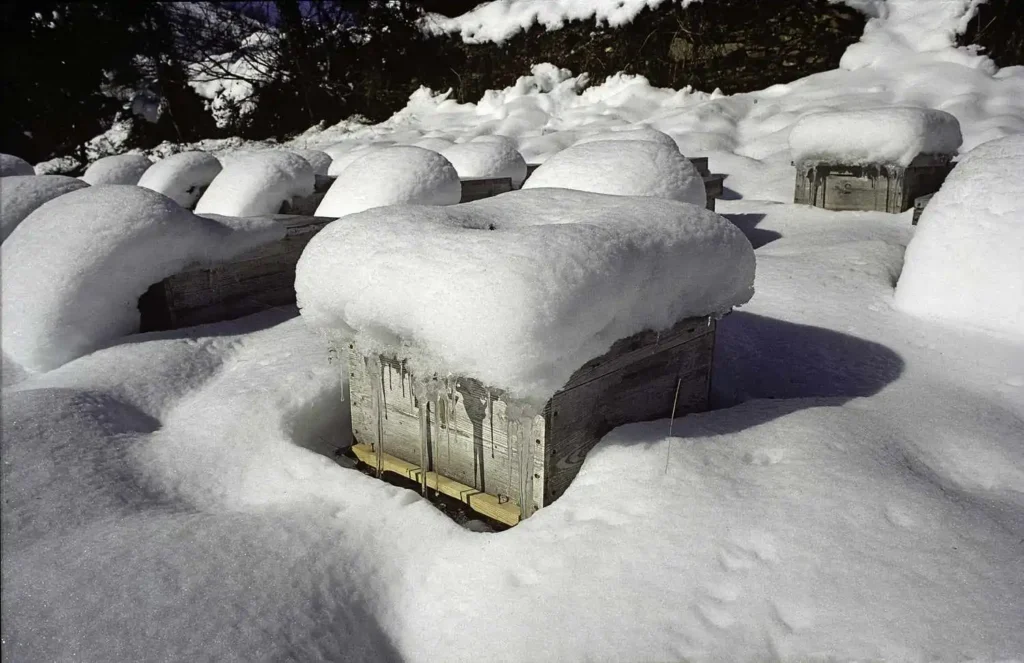
This is the most frequent question that I receive once the “bee season” has come to a close. Winter can be defined by more than just dates for honey bees. In their world, it is defined by the availability of food and the ability of the hive to collect it. Food for bees is nectar and pollen augmented with a boatload of water. Plants produce both nectar and pollen and honey bees are “generalists” that will visit a variety of flowering plants including trees, shrubs, perennials and flowers. The ability of the hive to collect it is temperature dependent. When temperatures begin to fall, the hive scales back gathering operations in response to both the temperature and the reduction of resources in the environment.
A colony of bees will have a population of ~50K – 100K bees. That’s a lot of bees that require a lot of food! No problem—there’s a lot of flowers in the spring, summer and fall to provide it. But the colony needs to survive the winter without fresh food so the colony must prepare by reducing the number of bees within the hive. The queen will begin laying less eggs to replace the number of dying worker bees. Typically, this begins in the height of summer and by late fall, the numbers of worker bees should be closer to the 25K to 35K mark. In addition, the queen begins laying a physiologically different worker bee called a “fat bee” which has greater fat stores which will allow her to survive the 4-month winter dearth. (A typical worker bee only lives 4-6 weeks.) Finally, the colony will boot out the drone bees. Drones are male bees that do not collect nectar, pollen or water. Their only job is to mate with a queen. (More on drones some other time.) As the drones are not contributing food, there comes a time in mid-fall when the colony decides that their mouths can no longer be fed and they are evicted from the hive and perish.
The queen must walk a fine line between having too many bees or too few bees in the colony. As Goldilocks says, she needs to be “just right”. Having too many bees may result in them eating more food than they have available and starving to death. Having too few bees may result in the colony being unable to maintain adequate heat in the cluster and the bees freezing to death.
The colony also needs to have stored an adequate amount nectar (now honey) for the remaining bees to survive. Beekeepers typically assess the weight of the hive by lifting it. If it can be lifted, it may need additional stores. If not, there is probably plenty of food. Food is one metric—but the longer I keep bees, the less credence I give to it.
Bees form a “winter cluster”. This is essentially a ball of bees, typically located in the center bottom of the hive. The queen is located in the middle of the cluster. The bees vibrate their wing muscles to generate heat. Most of you have seen the video of penguins where the inner penguins in the cluster move to the outermost regions and outer penguins move in in a constant rotation to keep everybody warm. The exact same thing happens in a bee hive. The colder the outside temperatures, the tighter the cluster. As the cluster consumes the honey stores that are within reach. The cluster will move upwards and/or outwards to secure more honey as needed.
Bees will remain in the winter cluster unless temperatures climb to above 50 degrees. Here in Colorado, we are fortunate enough to have high pressure ridges which allow temperatures to rise to the level where bees can take flight. These generally occur on a 3-4 week cycle all winter long. The cluster will loosen and “break” and some bees will take cleansing flights to defecate. In the upper states of the US, bees may be in the cluster from October until April!
Bees aren’t the only ones preparing for winter—so are the beekeepers. We spend considerable time and money ensuring bees are ready for winter, too! At Bee Squared, we have a rigorous certified organic Varroa mite medication program to reduce the number of mites in the colony to manageable levels. We reduce entrances so that the bees have less cold air coming in. We insulate the hives with a black insulator that allows for better heat absorption and creates a “dead air” space around the colony to help the colony stay warm. Finally, if a colony is weak, we put them in hospice care and give them a feeder. A colony on a feeder is usually a dead colony in the spring but it makes me feel better to give them better odds.
This “winter” has been an aberration. Up until just a few weeks ago, there has not been cold enough temperatures to keep bees inside the hive in the cluster. It will be interesting, perhaps in a very bad way, to see what has happened come spring. Cold is one of the primary killers of smaller hives as they struggle to keep temperatures in the mid 80’s. No cold? Perhaps we will have greater success in overwintering smaller colonies this year. No cold? Perhaps we will have too many bees flying. Flight consumes energy—food. Maybe we will see more colonies starving even though stores felt adequate in the fall.
There are a lot of factors that have to be in sync to achieve overwintering success: colony numbers, mite numbers, queen quality and food all play major internal roles in colony success. External factors such as winter length, winter extremes (going from “normal” to exceedingly cold) and duration and frequency of winter extremes also play a significant role in colony overwintering success. In addition, there are other externalities such as climate change, pesticide exposure, forage quality and quantity and other minor pests and diseases also working to make overwintering challenging. Nationally, this country continues to lose approximately 60% of its bees every winter. This is not the way it used to be and it is not the path forward to success.
Time will tell if my, as well as the colony’s, fall preparations have been adequate. Spring will be here before we know it!

This website uses cookies to ensure you get the best experience on this website